Today I crossed the 100 km pedestal between Sarria and Portomarin, marking the beginning of the Camino for many but near the end of my 811 km journey.
It was one of the longer stages, and there were many more people on this section of the Camino, as expected.
The entrance to the city of Portomarin was over a very steep stone bridge, with about 50 tall steps to reach the top. Just what you want to see at the end of a long day of backpacking!
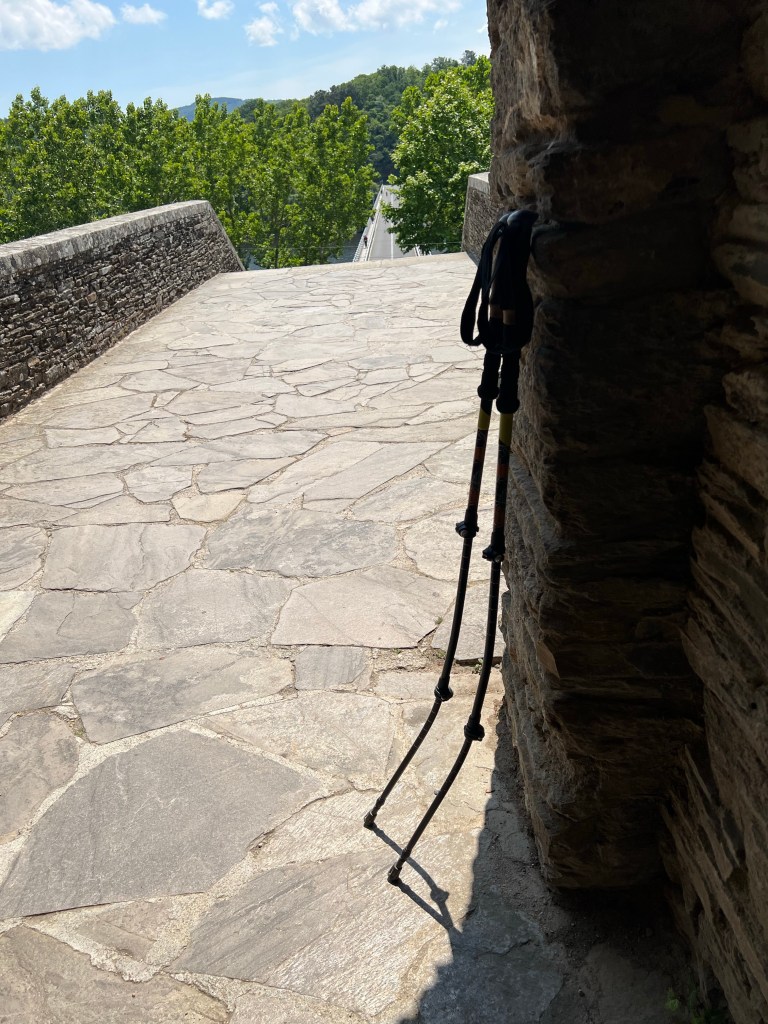
At the top of the bridge, my hiking poles broke the fall of a fellow peregrino who had turned to take in the view. He was not hurt, but my poles were bent into two perfect crescent moon shapes.
He was very apologetic, but I told him as best I could that it was not a serious problem, and that the important thing was that he was not hurt. Falling down even part of those stairs could be serious.
I learned later that the arched bridge could be avoided on surface streets. This would be advisable, since it is a long climb with a heavy pack and no handrails.
I walked a few more blocks to my albergue and checked in.
I showed the hospitalera my bent poles and asked if there were a peregrino shop in town. She said there wasn’t. After a moment, she excused herself and came back with a set of poles that someone had left behind in previous years. As they say, “the Camino provides!”
(I will re-donate the poles to the next needy pilgrim at the end of my journey).
The albergue was huge, with 120 bunk beds in a single large room, separated into groups of 40 with hanging sheets.
There was a strong smell of insecticide, which I took as a hopeful omen for the lack of bedbugs.
I managed to get a lower bunk and started setting up my sleep space.
There is a method for dealing with sleeping albergues, and it is more work than staying in hotels. First, you need to store your dusty shoes and poles in the designated place, generally near the entrance. Then, you make up the bed if sheets are provided. Most people travel with a sleeping bag liner in case they are not.
Then, you organize whatever you might need in the night before stowing your pack. I used my lightweight day pack to collect toiletries, bath towel, electrical charges, ear plugs, water, etc.
On a lower bunk, you can use an S hook to hang your day pack out of the way (if you remembered to pack one).
Then shower, laundry, and finding an AC outlet (if you’re lucky). I was happy for the extra weight of my portable charger on these nights.
This particular process was was complicated by the arrival of the group of 100 or so eighth-graders. They were hiking with day packs, but a bus soon arrived with their suitcases, making the narrow aisles very tight.
There are always a few hours to kill between your arrival at, say, 3 and your dinner at 8 or 9. This is a perfect time to rest after your long hike, and maybe take a nap.
But not with 100 eighth-graders. It’s not that they were poorly behaved, but they were loud, playing games and jumping from bunk to bunk like spider monkeys.
Earplugs afforded me a little rest before going out to inspect the 100 meters or so of downtown in this small city. The cathedral was locked, as most things are between 3 and 6.
If you can push your dinner as late as possible when staying in an albergue, you’ll come back at around 9:30 before the doors lock at 10.
There were no blankets on the beds at this albergue. Some people travel with a light blanket in their pack. It was cold, so I asked if I could rent a blanket, as I had done at another place. The hospitalera said to check again at 9:00.
The young people were fairly quiet after lights-out. I realized that one advantage of having them there in such a huge room was that there were relatively few snorers—the bane of albergue sleeping.
And yes, I got the blanket.
 Don's Camino
One response to “May 22nd”
Yay, you got a blanket! Reading your blog is a joy!
LikeLike