Today was the 10th stage of the traditional Camino Francés. A fairly easy stage.
I’ve been lucky with the weather so far. It was warm today, but not too hot. I understand it is currently pouring over the last 100 km of the Camino, but that is still 2 weeks away for me.
I managed to get to Belorado before everything closed and had some tortillaespanola. I checked in at my albergue with a line of other tired pilgrims. The hospitalera very kindly spoke to me in very deliberate Spanish. I asked for the peregrino dinner and “take-away” breakfast (I learned that it was necessary to use this expression in English).
This place has a pool (!), but it was too cold to go in it, and I didn’t want to deal with the extra wet clothes. One of the other peregrinos did, though, and was shivering when she got out. I put my feet in for a few minutes.
I was seated for the pilgrim’s dinner with two ladies from Japan and one from Korea. Fortunately, their common language was English. Food was only okay, but good enough.
I realized that none of the beds had blankets on them. Or sheets, but I have my own sheet. I asked about it and was able to rent a blanket for 2 euro. Good thing, as it was way too cold to sleep without one!
It is a long, 23 km climb to San Juan de Ortega tomorrow. I couldn’t book a bed there, so I’ll either need to walk another 10 km to the next town or try my taxi luck again.
It must be Saturday, because it was hard to get a dinner reservation.
It took a few calls this morning to get a taxi from the truck stop back to the Camino. The front desk called the driver whose number is posted on the wall and in every room, but he was busy.
Finally the driver from yesterday picked up and agreed to take me back to the Camino.
Difficult, but not impossible.
My reading glasses came apart in my hand as I got into the taxi. Very glad I didn’t leave my spare pair behind in Pamplona to cut down on weight.
Today’s hike to Santo Domingo de La Calzada was a “normal” distance, about 20k, through vineyards and a few rolling hills. The weather was nice, although rain is expected later this evening.
I had somehow booked a Parador hotel for tonight. Very fancy—it must have been the only thing available without a taxi ride when I was trying to get things nailed down. Paradors are historic buildings converted into hotels by the Spanish government. This one had been a pilgrim’s hospital built by the hermit St. Dominic in the 12th century. I’ll make up for the splurge tomorrow by staying in a 12-Euro albergue. Maybe I’ll get the bottom bunk this time.
Many of the Paradores and municipal albuerges were built in the Middle Ages as pilgrim’s hospitals. Pilgrims were generally too sick, or too exhausted to continue along the Camino at various points.
I washed my clothes in the sink and took a shower, then headed out to find a snack (what we would call “lunch“—as I’ve said, there is no precise word in Spanish) before everything closed at 3:00.
A couple from Scotland that I had met on the Camino invited me to share their table at a cafe in the PlazaMayor. Gwyneth and Phil were doing their first Camino, in celebration of his retirement and in observance of his father, who passed away in January at the age of 99.
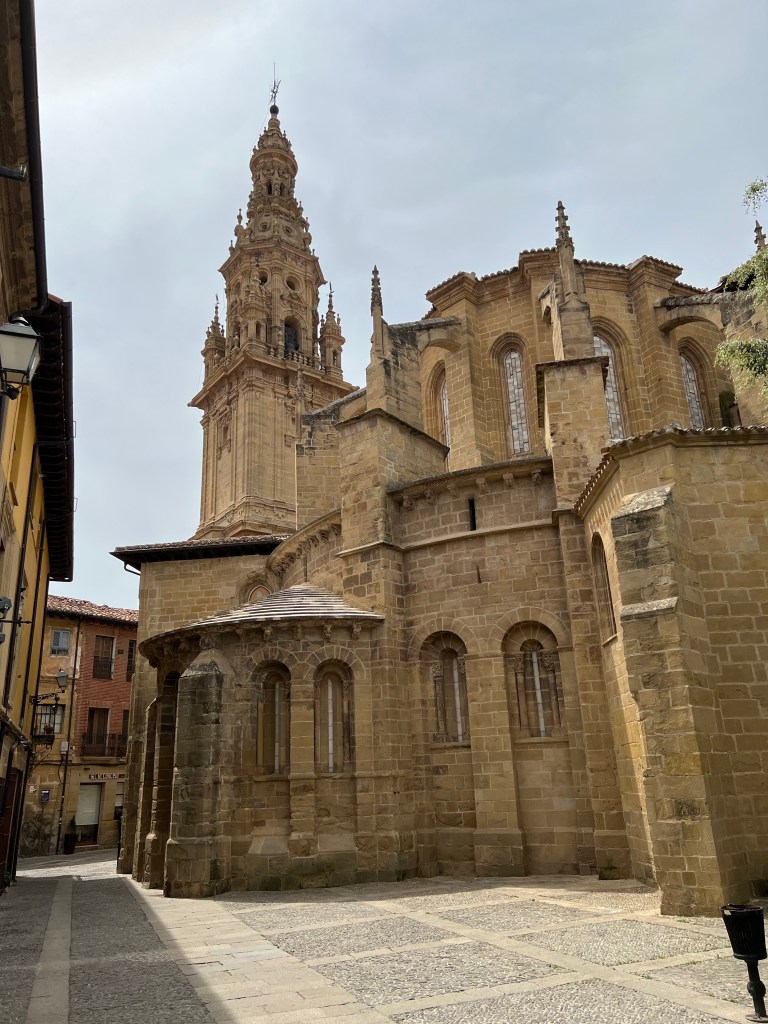
The cathedral of Santo Domingo de La Calzada was open, unlike every other cathedral I’ve seen so far. Apparently it costs 5 euros to go to church here, but the interior was stunning.
The ticket included admission to the clock tower, so I went inside. The lady directed me to a stone stairway that went up—and up and up. Not exactly what I had planned after a long day’s hike.
The stairs were very tall, even for me. How did the medieval monks manage it?
I enjoyed seeing the internal clockworks, based on the original mechanism driven by sand bags. When I reached the clock, I thought I must be near the top. If you look at the photo, I was only about halfway.
I decided to make a dinner reservation at the Parador, which is also known for its food. The kitchen opens at 8:30, but they could not seat me until 9:00.
I ran into my “Camino friend” Bronwyn from Australia for the 3rd or 4th time checking into the Parador. She is doing a better job keeping on “pilgrim time,” and had found an early dinner nearby at 7:30.
The dinner at the Parador was very good, and I was in bed by 10.
It was another long, 28 km hike, but the terrain was gentle and I did most of it before it started getting too hot.
If you read all of the guidebooks, subscribe to all of the forums, and ask experienced peregrinos, the normal advice is to book your lodging about 2 days in advance. This is useful, since you never know how far you are going to get on a given day, and it allows for a certain amount of serendipity.
I was not able to find a bed in Nájera tonight, in spite of starting the process several days ago. I tried booking.com, Expedia, Google, and gronze.com (Spanish only). I even sent a WattsApp message to an albergue that advertised on a fence along the way (everyone outside of the US everyone uses WattsApp instead of SMS).
The Camino is very busy this year.
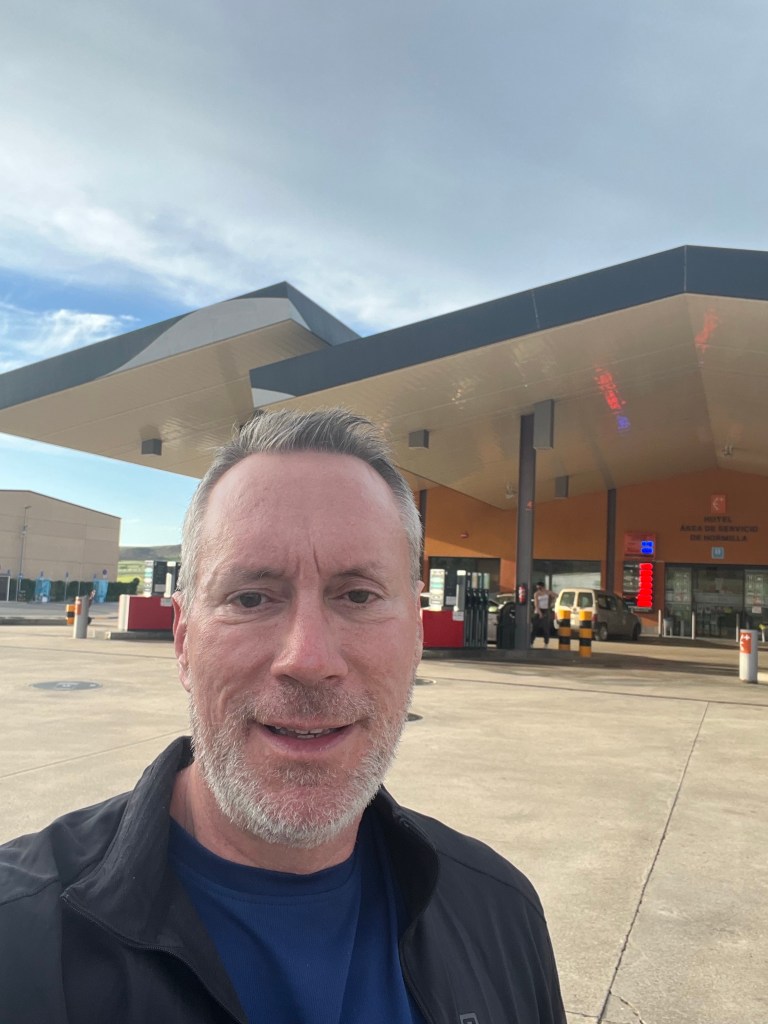
So I booked a room 5k away in a nearby city–in a truck stop, as it turns out.
I had been concerned about the extra mileage considering the distance of today’s hike, but in the morning my phone’s GPS told me I could make it in 5 hours. A relatively short day on the Camino.
Along the way, I walked with an Australian guy named Mick. He asked me if I needed a bed in town. His group had booked 8 beds in an albergue that held 9.
I said no thank you, I had booked a room out of town that was actually closer than I thought.
But the next time I checked my GPS, it was 8 hours away, not 5. It had been directing me to the wrong town, in the opposite direction. It was not the first or last time this would happen.
Lesson 1: If someone offers you something you need, take it. These people are called “Camino Angels,” for good reason.
I made it into Nájera at 2:45, right before everything closed for siesta. I bought the last soggy bocadillo in a cafe and asked about a local taxi service.
The number on the card repeatedly went to voicemail, but the website on the card listed a completely different number (ah, Spain). The fellow said he could pick me up, but it would be 40 minutes. I said okay.
5 minutes later, he pulled up, with another passenger in the car. Asked me if I wanted to ride with him to his next stop. A few minutes later, we were inexplicably at the truck stop (ah, Spain).
Lesson 2: You can probably always get a taxi, even in small villages. It is not cheap, but people need to make a living. I will need this insight several more times on the Camino.
My room at the truck stop was actually completely acceptable, and relatively quiet. I’ll need to find a way back to the Camino in the morning. I asked the driver if he could give me another ride tomorrow, but he said 7:30 was too early. (Spain).
Lesson 3: Pilgrim time is different from Spanish time.
I’ll work something out in the morning. Only 20k tomorrow.
Dinner at the truck stop wasn’t bad. The calamari was only so-so, but the sausage soup was excellent.
Today was the longest hike so far, at 28 km (17.4 mi). Most of the climbing was in the first half, so I left early to get a jump on the heat of the day.
Breakfast was a cellophane-wrapped sandwich from the only place that was open. Chicken salad, I think. On Wonder Bread. But on the Camino, you have to eat what you can, when you can.
I stopped about mid-way at a tiny food truck that had somehow climbed the trail to a wide spot and set up shop. I’ve seen 3 or 4 of these on the Camino so far. I ordered a slice of tortilla española, and it was the best I’ve had so far.
At some point on today’s trek, I passed from the region of Navarre to the region of Castile. Both were independent kingdoms until Spain was unified.
Also entered the territory of Rioja, famous for its wines.
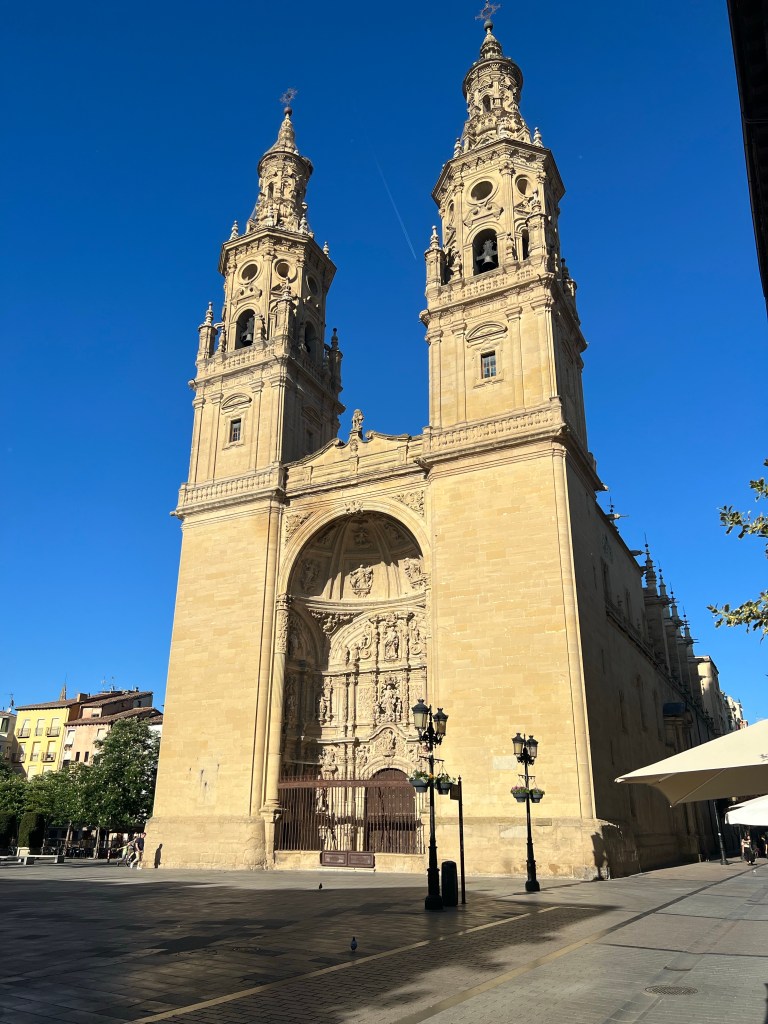
The cathedral at Logroño is impressive, but, like all cathedrals I’ve seen so far, was closed.
Tomorrow is another 28 km hike to Nájera, with more climbing than today.
I was happy to have the sandwich I made for breakfast, so I could avoid the delay in hunting down the store that didn’t open until 7:00.
Got an early start while it was still cool.
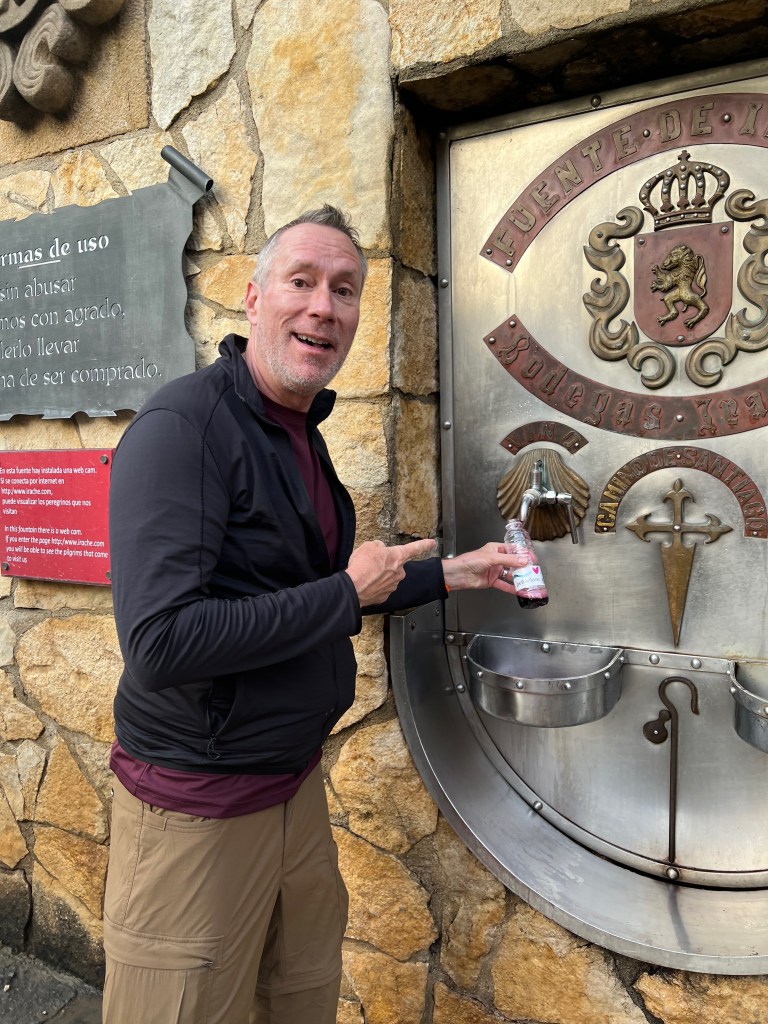
The highlight of the day was stopping at the wine fountain at the Monasterio de Irache. Wine on the left, water on the right.
Monks have been serving wine to pilgrims here since the 10th century. It is owned by a winery now, but every morning pilgrims still line up.
I only had a sip, but the wine wasn’t half bad. Some pilgrims filled their entire water bottles. The monastery is only half an hour in to an all-day hike, so I hope they don’t try to drink it along the way.
I went through exactly 2 liters of water on today’s hike. That’s 4.4 pounds to carry, but todays hike didn’t have any refilling stations after Irache.
The town of Los Arcos is tiny, about 1,000 inhabitants, and based on a Roman site.
Tomorrow’s hike and the next day’s are two of the longest hikes on the Camino, around 28 km each. Better get an early start.
The famous wine fountain at the Monastery of Irache
The famous wine fountain at the Monastery of Irache
The weather is heating up, unseasonably I’m told. My strategy of getting an early start was helpful, as I got the strenuous climbing in early, and had to hike only the last couple of hours in the heat of the day.
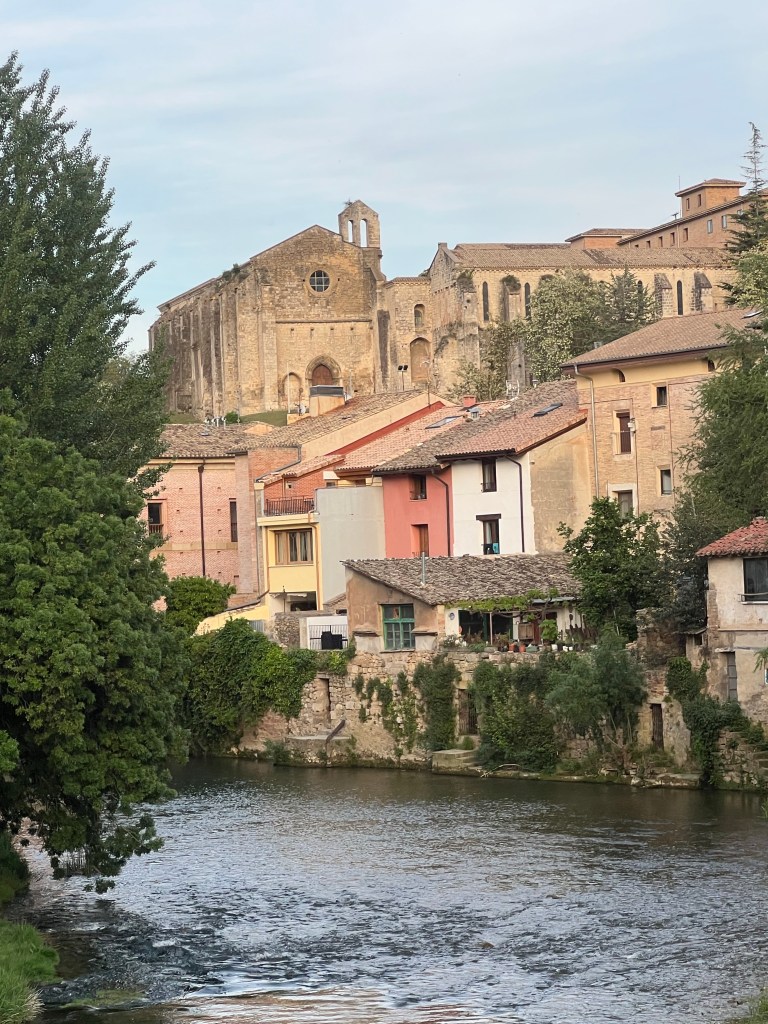
I made it to Estella around 1:30 and checked into my hostel. The albergues have been full in this part of the Camino, but private rooms in a hostel or pension are not very expensive–generally around 55 euros instead of 12 to 15.
It’s a small town, with a mix of very old and unfortunate 1970s architecture. A peregrino tends to arrive hungry after a long days hike, so I made my way to the plaza mayor (main square) for lunch.
Pilgrim meal times are much closer to California meal times than Spanish meal times. Ideally, a pilgrim would like breakfast at 6 or 7 for an early start, lunch at 1 or 2, and dinner around 6 or 7. Spanish meal times are about 2 hours later, so it is sometimes a challenge to find food.
Spaniards do not really have a breakfast, but rather a piece of bread or pastry with their morning cafe con leche. There is a more substantial meal around mid-morning for desayunos (breakfast). There are two afternoon meals, both ambiguously called comida (food), around 2:00 (before siesta) and 9:00 (when most pilgrims start to go to bed). Most places are closed from 3:00 to 6:00.
I’ve been very lucky with my gear so far. The two most important things are your shoes and your pack. I went through a couple of pair of hiking shoes before picking these, and have been blister-free for the first 5 stages. That bodes well for the next 29!
Many people I’ve met have been completely debilitated by blisters from the first day, making a tough day even tougher. I have all of the necessary gear for this, but have not needed it.
Tomorrow’s stage starts with a steep climb for the first 7k, followed by a long, gentle descent. Tomorrow will be even hotter than today, so I’ll use the same strategy of starting early.
Oh, and no breakfast in the hotels here. My hospitalera said I could walk about 1km in the wrong direction to buy a sandwich at a drug store that opens at 7. There is no food for breakfast or lunch on tomorrow’s stage.
Fortunately, I found a shop nearby with 1 baguette left, and bought some jamon and queso to go with it. So I’ll be making my own breakfast and lunch before I go.
I left Pamplona early this morning for the hike to Puente La Reina (Queen’s Bridge). A long uphill climb to a wind farm followed by a steep, gravelly descent.
I left a few things from my pack behind in Pamplona—anything I was not sure I was going to need. In general, you just need the clothes you’re wearing and the clothes you will wear tomorrow.
Every ounce counts. I took a pound or so out of my pack, and really felt the difference. Also ditched my color-coded packing cubes. My clothes fit in the pack much better if they can find the little nooks and crannies.
I have spoken to several other peregrinos who have also left things behind. No matter how much research and preparation you do, you learn a lot once you start your Camino. I don’t like being wasteful, but I had to tell myself, you’re not going to make it if you don’t get rid of this stuff.
The goal of today’s climb was Alto del Perdón, the mount of forgiveness.
Alto del Perdón is home to a wind farm. Windmills in both directions as far as you can see.
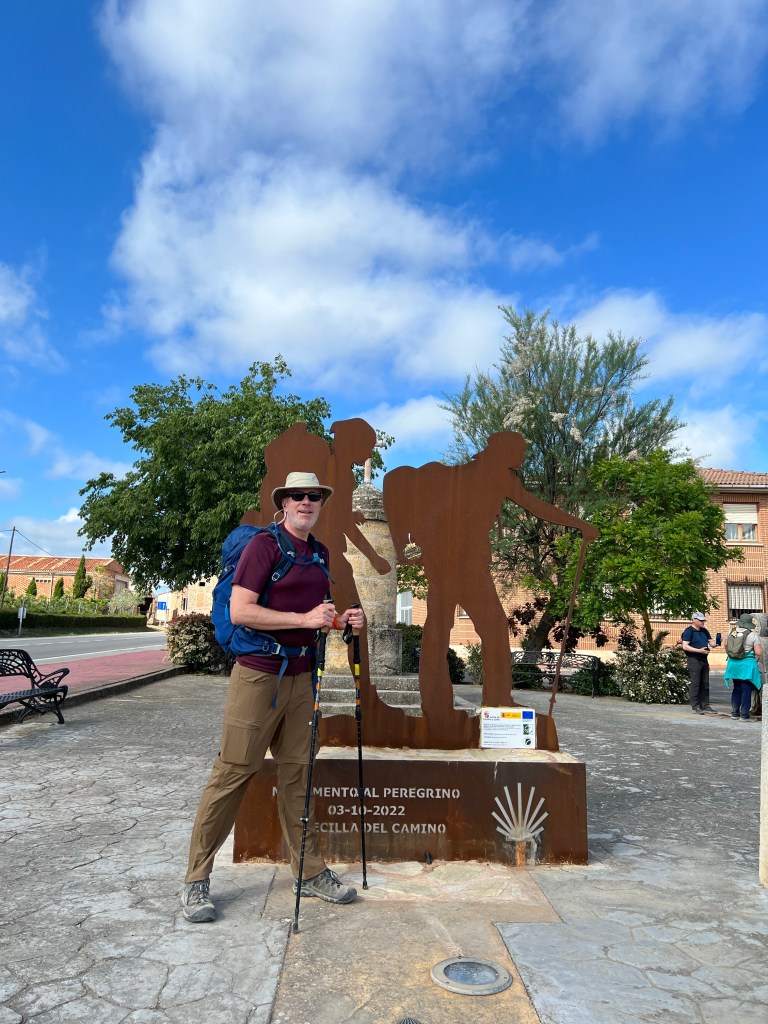
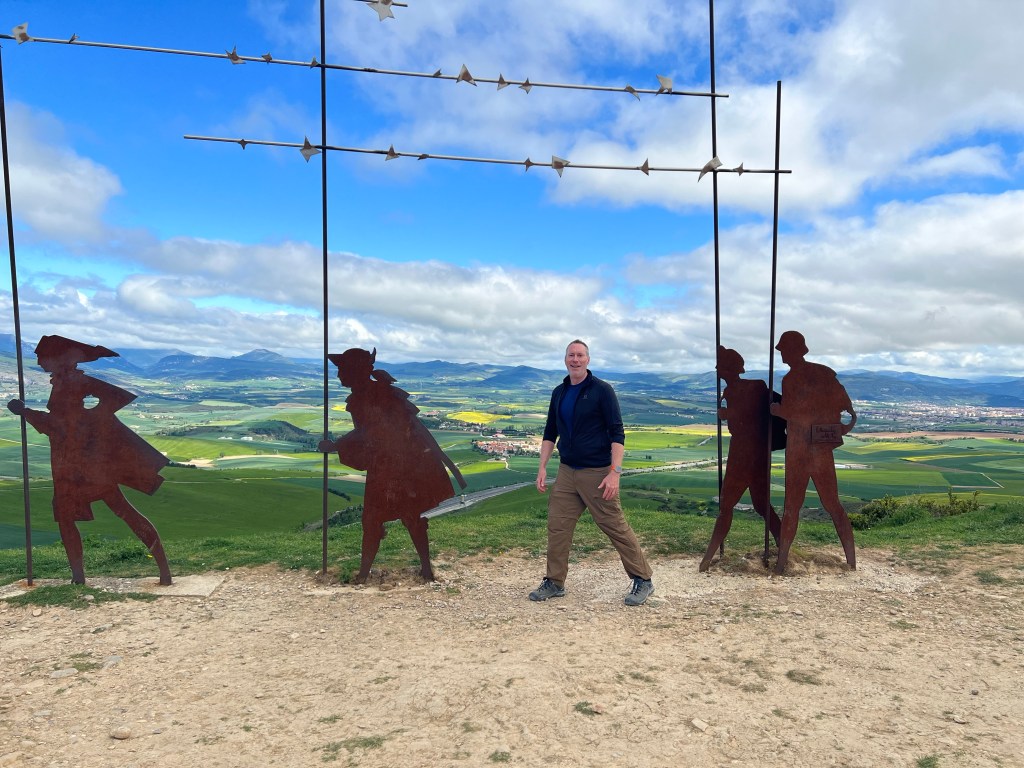
A fellow hiker offered to take a photo of me at the iconic sculpture there (you’ll know it if you’ve seen the movie, “The Way,” with Martin Sheen).
The sculpture depicts a life-sized line of pilgrims making their way along the Camino. On closer inspection, the pilgrims progress through time, from the Middle Ages through modern times.
The woman who took my photo insisted that it was tradition for me to stand in the space before the last pligrim and pretend that I was hiking with them. I complied.
The descent was difficult–perhaps the most difficult descent of the Camino. Steep, with loose rocks and plenty of places to trip.
The Queen’s Bridge dates back to the 12th century, and spans the river Arga. It’s a magnificent structure with six large arches across a broad stretch of the river, built to facilitate the safe passage of medieval pilgrims.
The city was under protection of the Knights Templar, but they did not have a fortress here.
I’ll be getting a early start tomorrow for Estella, as it is starting to get hot. My Brierly guidebook says 3 steep climbs to 3 hilltop villages followed by a gentle slope down.
I started my day in Pamplona by walking to the corral de toros, where the bulls are gathered prior to their famous run.
The Festival of San Fermin is in July, so there were no bulls today. As a young man, I considered coming for the festival while living in Paris for a short time. But we learned that our first child was on the way, and a change of plans was in order.
An idea that was foolish at 27 seems ludicrous at 60.
I traced the path of the Encierro from the corral through the streets of the old town to the bull ring. The path is marked by 12″ x 12″ holes in the ground, where the guard rails are constructed during the festival.
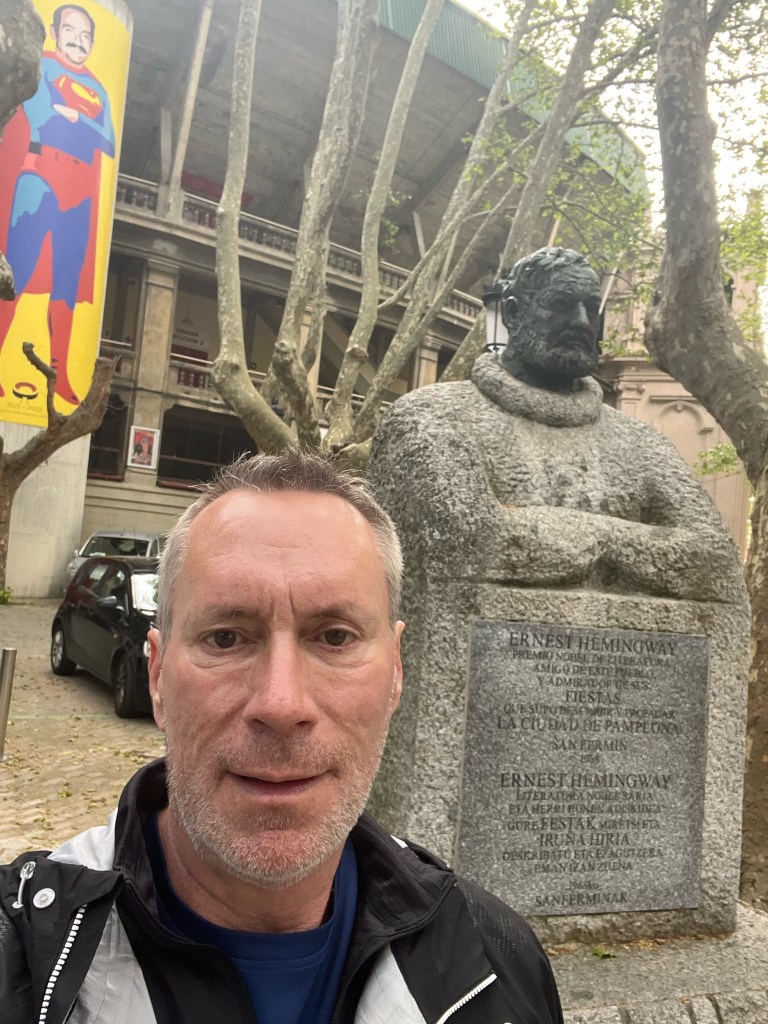
There is yet another bust of Hemingway outside the bull ring. He attended from 1922 until 1959. He worries that he’d spoiled the event by writing about it in The Sun Also Rises (he was right).
The guided tour was fascinating and well organized. I took some photos of the different areas and a few of the stands from the perspective of the bull.
A number of years ago, I made the mistake of taking Victoria to a bull fight in Madrid. I had read about the sport in Hemingway’s Death In The Afternoon, so understood a little bit about it’s history and traditions.
She was horrified that all 6 of the bulls were killed over the course of the afternoon. She was under the impression that if they did a good job, they would be set free.
I managed dinner at Cafe Iruña, the famous 1888 Art Nouveau restaurant on the plaza. The food was only mediocre, but the architecture is unforgettable. And of course, it was also a Hemingway haunt. Instead of a bronze bust, they have a full bronze statue of him.
Service was leisurely, even for Spain. Most Americans don’t expect a 2 hour dinner.
I have another big climb and tricky descent tomorrow.
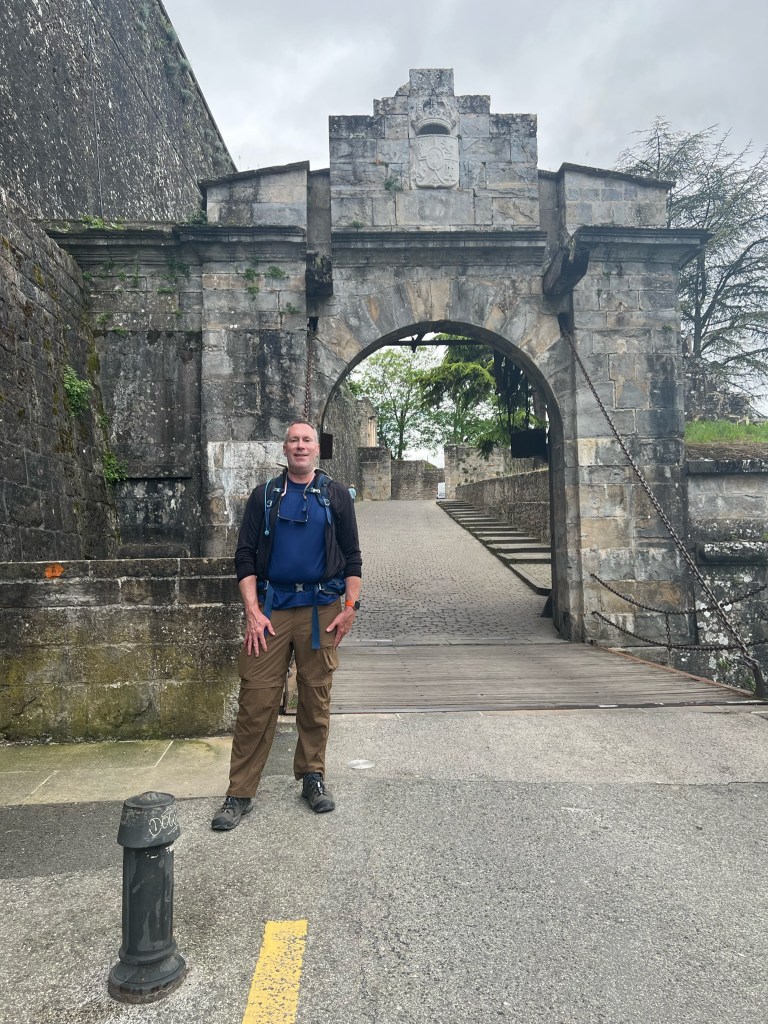
I entered Pamplona today through the medieval stone gate that still had its drawbridge mechanism. A fellow peregrino took a photo for me.
It was one of the “easier” hiking days, with only a few steep climbs over 5 or 6 hours. The countryside was beautiful in the foothills outside of Roncesvalles.
I’m staying on the Plaza de Castillo in the center of the old town. It is beautiful and packed with people on a nice Saturday afternoon. (I later learned that many would stay up in the Plaza until 4 or 5 in the morning, noisily.
As a treat, I reserved a room at La Perla, where Hemingway stayed and wrote about in The Sun Also Rises (under a different name). There is a bust of him in the lobby and a few artifacts.
Also in the lobby is a switchboard that operated here from 1920 until the 1990s. This was one of the first electrified buildings in the region.
Peregrinos arrive hungry, as our daily routine does not mesh well with Spanish meal schedules. We generally arrive during siesta, when everything is closed, and have to wait until dinner to get food. I was the first one in the restaurant at 9:00 PM for dinner!
Today was the toughest day of the Camino. On day 1, you hike about 25 km and climb 1,429 meters.
I woke up speaking French in St. Paul Pied de Port, and went to bed speaking Spanish in Roncesvalles. (They would have preferred Basque, but more on this later).
About 5 hours in, you reach the auberge de Orisson. You’ve climbed perhaps half of the altitude at that point. The auberge has beds for about 40 people, which book up fast. Staying overnight there, or at the small auberge in Borda a few km up the road, is by far the most practical strategy.
The full hike to the summit took me a total of 10 hours. I put a lot of weight into being “reasonably fit.” After all, lepers, amputees, and gravely ill people have been doing this hike for 1,000 years! I’ve run a bit, 15 or so 10 or 12ks a year, couple of half marathons, a 100-mile bike race a few years ago—not an athlete by any means, but no slouch, either.
But I’m quite sure today’s hike was the most physically demanding thing I’ve ever done. I wanted to throw in the towel many times, if there had been any way to do so.
Breakfast was a slice of tortilla, the saltiest I’ve ever had (but I was thankful for the salt). A gentlemen in his 70s from Ireland sitting next to me chased his with a brandy.
At the summit, called Lepoeder, both Napoleon and Charlemagne lost their armies (and, arguably, Europe) in the ninth and nineteenth centuries, respectively. The pass over the mountain is called La Route Napoleon, but there are references to Charlemagne’s general, Roland, along the way as well.
Do the Route Napoleon, they said. The view is incredible, they said. But by the time I reached the summit, the last thing I was thinking about was the view.
The last few km are a 1,000 m descent into Roncevalles, largely in a very rough, very steep gully. The hiking poles came in handy. Falling downhill with a heavy backpack is, as outdoorsmen say, a very bad thing.
On the other hand, there is a great feeling of accomplishment at the end of the day. I missed my blog posing in the evening, because I simply could not move my thumbs.
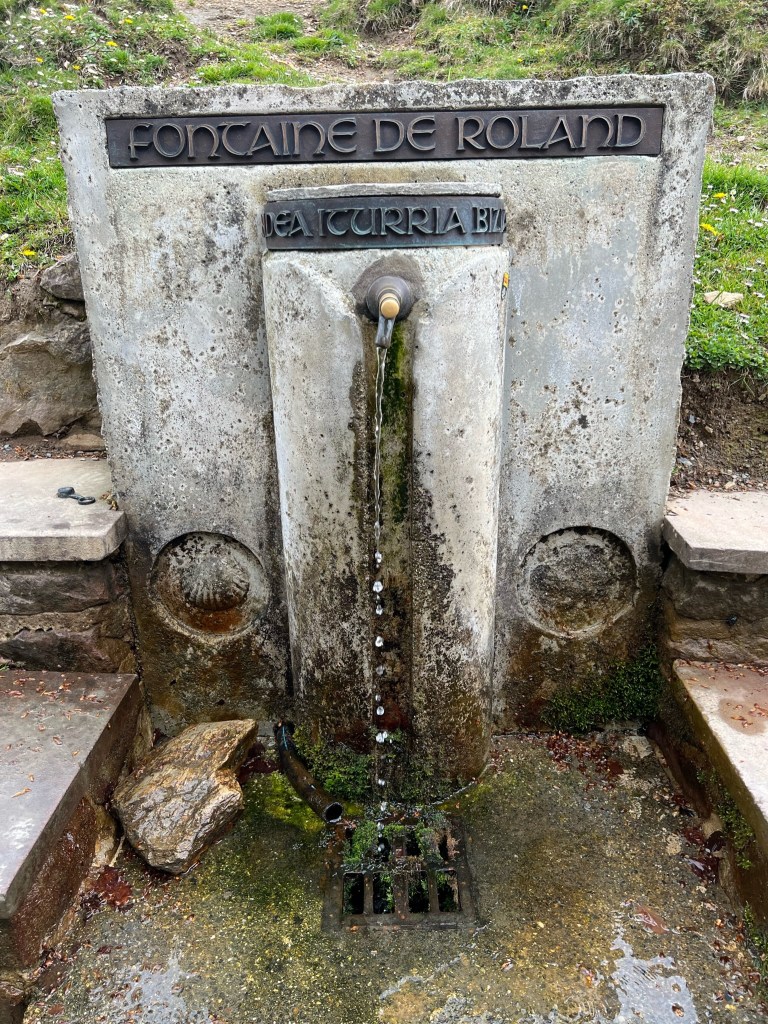
The Fontaine de Roland, where Charlemagne’s army was defeated by the Basques
 Don's Camino