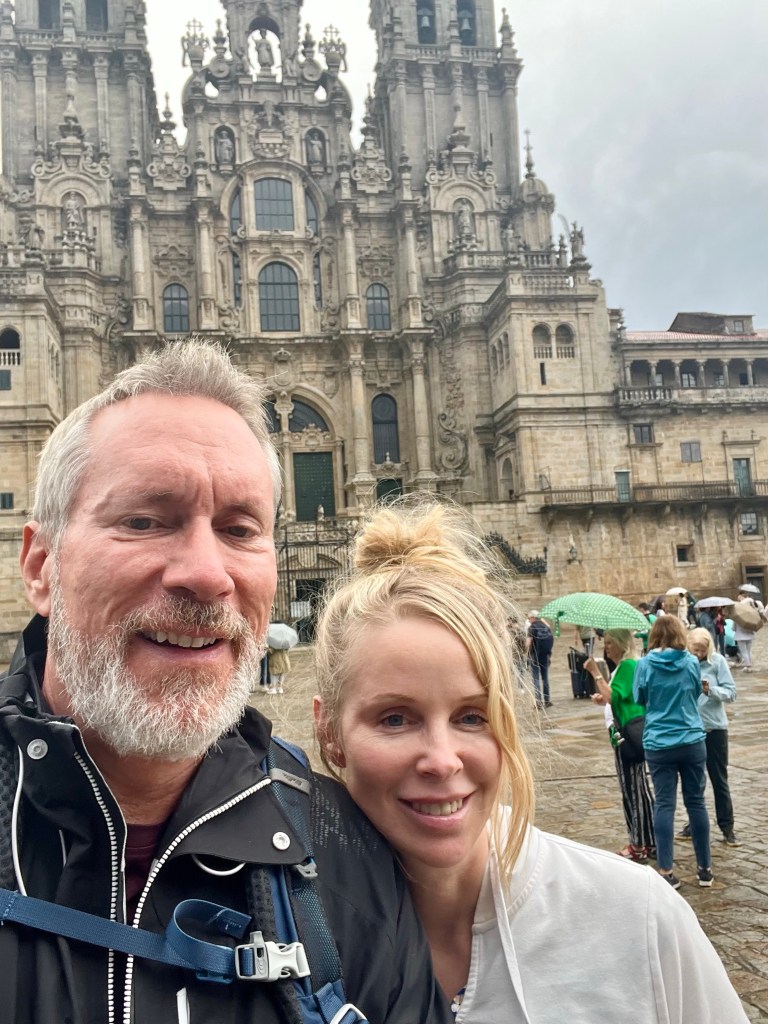
Victoria arrived this evening and gave me my official welcome to Santiago at the 0 km marker in front of the cathedral.
She had a long-ish transfer in Frankfurt so had a full day of traveling.
Somehow, she met a German woman in the Santiago airport who offered her a ride into town with her husband. They were able to get her within 100 m of the hotel, but not quite close enough for her to find it easily.
We are having dinner with the German couple tomorrow night.
After taking some photos, we walked around the old town and listened to the bagpipes and the church bells. Lots of beautiful architecture here.
Don Vicente called while I was waiting for Victoria. He said he was no longer living with his sister in the home he’d grown up in, but had moved to a residential facility for retired priests in Mondoñedo, about 150 km away.
I told him I’d meet him there, and we settled in lunch at 14:00 on Tuesday.
We had an early (for Spain) dinner and hope to get some rest before our coach tour of the coast in the morning.
Victoria greeting me outside the cathedral in Santiago.
I have now officially been on this journey for over a month now. Victoria will get on a plane “today” (it is already Friday here), and meet me in Santiago tomorrow evening.
I’ll hike the final stage today, 21 km, and take care of some administrative things while waiting for Victoria’s arrival.
The guy at the cafe recommended a toasted Serrano ham and cheese croissant for breakfast as an alternative to the normal tostada con mantequilla. It was delicious!
I had heard of the place that gave wax sellos (stamps) in the pilgrim passport. Turns out he was in a van at about the 10-km mark along today’s route. I stopped for a stamp and bought a couple of patches, now that I need to carry them only another 10 km (not 100 km or 800 km).
We finally got a little bit of rain today. Not enough to make conditions dangerous, but enough to break out the rain gear. My lightweight jacket and backpack rain fly for the backpack did their jobs well.
I’m saying at a pension on the outskirts of Santiago tonight. Victoria is arriving tomorrow, and we’ve arranged for her to greet me “formally” in the plaza in front of the cathedral when I arrive.
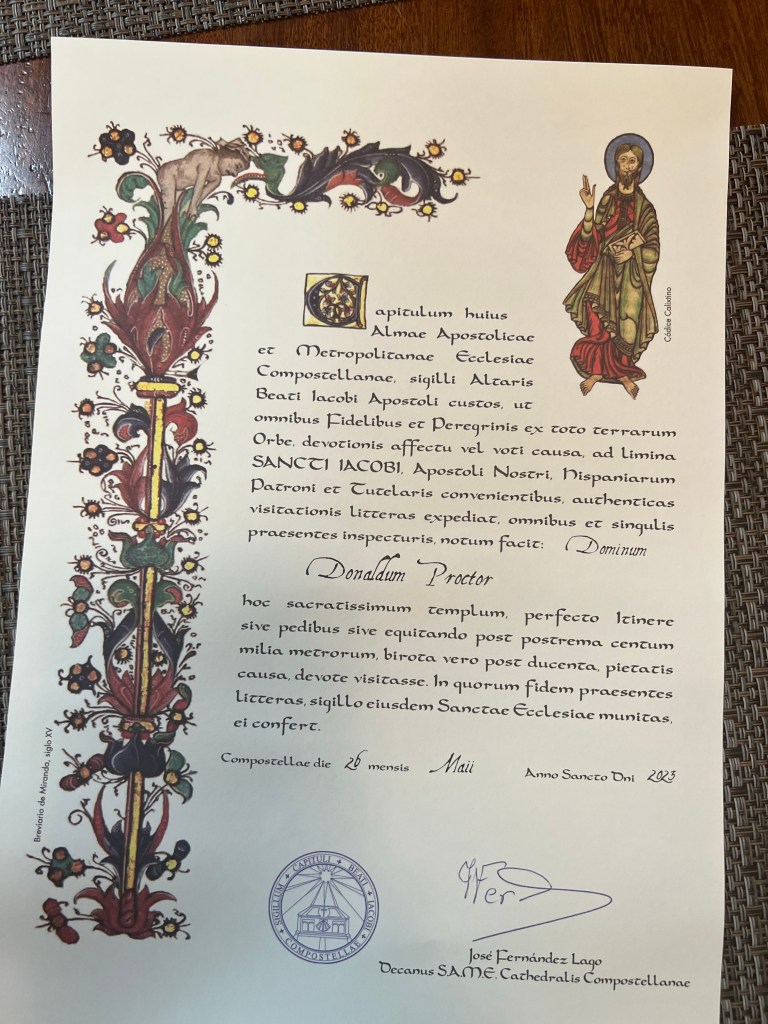
In the mean time, I got the required additional stamps to fill my pilgrim’s passport and receive my official “Compostela.”
I can only make out a bit of the Latin, except for my Latin name, “DonaldumProctor.”
My official Compostela after completing the Camino de Santiago.
I ordered caféconleche, xugodenaranja (Galician term for fresh orange juice), and tostado for breakfast. She asked if I would like marmalade and margarine (mantequilla) with that.
Add to the list of things I eat here but never eat at home: margarine.
It was a relatively easy hike of 21km, about 5 hours with a pack. Unlike the eastern part of the country, much of the trail in Galicia is shaded by trees. It is warmer here, though, in the mid-70s, and prone to rain.
I’ll arrive at the outskirts of Santiago tomorrow having avoided a single day of hiking in the rain. That is a small miracle. Others who started slightly earlier have had days of rain hiking. You prepare for this, of course, but when your socks get wet the chance of blisters goes way up.
My comida (“food”) meal this afternoon was in one of the two restaurants in town. The menu had the choice of either a 1 kg or 500 g steak. I asked if he had something smaller, and he turned the menu over to show a 350 g steak (about 12 oz).
It came seared but uncooked and sliced on a plate. Then came a huge stone platter that had been heated to at least 500 F. Without explanation, I figured out that I was supposed to cook the meat at the table.
I’m addition to the requisite French fries (patatasfritas), it came with a big green salad. Never a huge fan of iceberg lettuce, it is often the only way you’re getting any fresh vegetables around here.
Needless to say, I didn’t need my second “food” meal 5 hours later, so I went to bed early.
A month ago, I didn’t know I could hike 19 miles with a pack.
Today’s 30-km stage, one of the longest on the Camino, was a mix of long climbs and rolling hills.
I’ve run into a fellow peregrino from San Diego named Louie a few times. Louie is 66, with hypertension and diabetes, and is generally huffing his way up a hill when our paths cross.
An accountant by trade, Louie immigrated to the US (legally, he emphasizes), in 1984 after finishing college and working in Mexico.
At some point, an associate offered him a job in the US servicing vending machines. He said the pay made it hard to turn down.
Louie now has over 500 vending machines of his own throughout the Southwest, and has made a comfortable living for himself and his family. A real American success story.
Why hike the Camino now? His answer was unexpected.
Stem cells.
Louie was diagnosed with long-Covid during the pandemic, and never got back on his feet.
At the advice of a friend, he went to Mexico for a stem call injection. Eventually he had a second one. He said they made all the difference in the world.
This 66-year old said he feels like a 26-year old, and joked that his wife was *very* satisfied with the results as well. I understand a small amount of the debate over stem cells in the US, and hope we are on the right path.
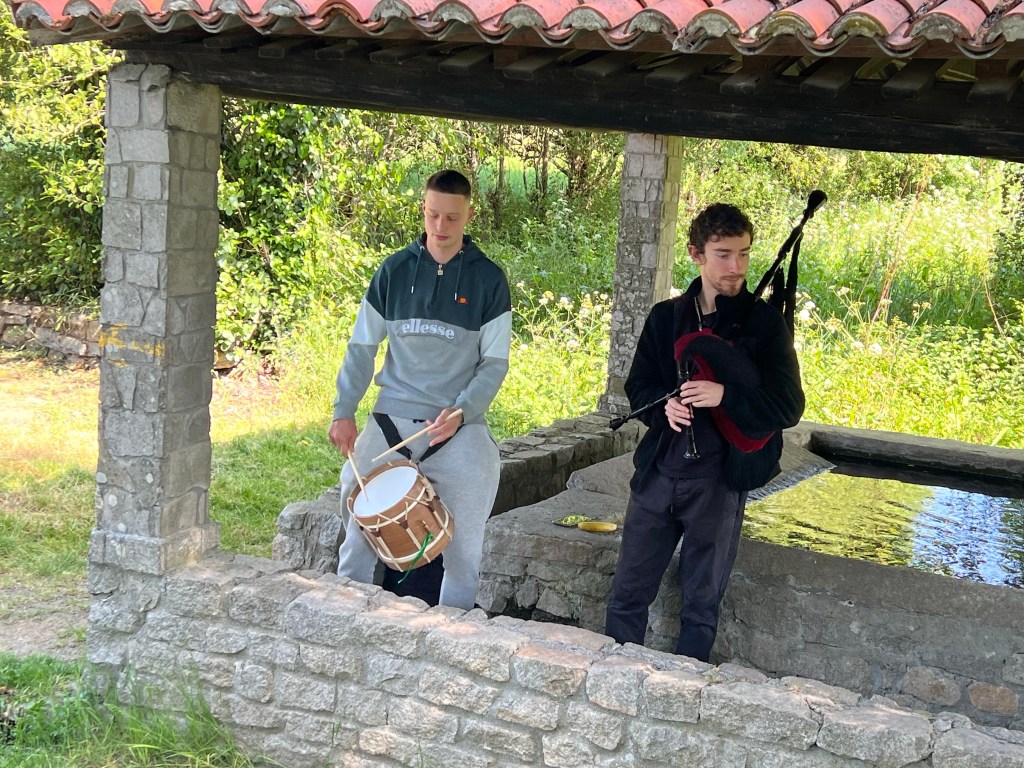
I had been waiting to hear bagpipes since entering Galicia a few days ago. I remember hearing them on the main square in Santiago in 1989. Most Gallegos consider themselves part of the Celtic culture, with traces in their language, iconography, and music.
Somewhere in the last 10 km of today’s hike I heard a drum and bagpipes in the distance. It was two young men set up in a lean-to on the side of the trail. I tossed a couple of Euros into their instrument case and took the photo below.
The Galician bagpipe is somehow different from the Scottish bagpipe, left handed and with different tuning, I think. The sound is subtly different, in a not unpleasing way.
Dinner was a very passable Paellamixta on the plaza, with a slice of local sheep’s cheese and honeycomb for dessert!
I walked today’s stage to Palas de Rei with my friend Mairéad from Ireland.
I met her a few days ago when we both took the “alternate path” to the wrong city, and had to catch taxis to where our lodging was booked.
It was a lovely walk, with no sunrise ascents or descents, and only 22 km. Most of the trail was along a wooded path through farming villages and pastures.
Stopped at a “bar” for a bite to eat about mid-way (everything here is called a “bar”). It was called the Paso de Formiga, which I recognized as having something to do with ants (Formosa from French, formic acid from English). Turns out it is actually Galician, as the Spanish word is the similar hormiga). One of many tiny clues from French that would help with my Galician, and later, my Portuguese.
And what did they have in the garden? Giant, car-sized ant sculptures.
Do you have things like this in California, Mairéad asked. Well, yes, I confessed. There is this thing called Burning Man…
Mairéad sat at a table while I waited in line to get some food. She requested a kind of packaged ice cream that was available almost everywhere along the Camino. Her favorite was the “magnum.” I couldn’t think of the last time I’d seen packaged ice cream, but perhaps it was from ice cream trucks in the 60s.
I got a sello on the way out, as we need to have two stamps per day for the final 100 km. The bar’s stamp had a trail of ants crawling across the border.
Palas de Rei is a small town, with a handful of restaurants and hotels. I had a delicious dinner of Galician octopus, a local specialty.
I have a private room tonight—with 5 beds!—but a shared bathroom across the hall. Quite an elaborate check-in procedure, all done via WattsApp in English and Spanish. Very efficient!
A place down the street opens early for breakfast at 6 AM, so I will get an early start on tomorrow’s long, 29-km stage.
At Paso de Formigas, Galician for “the pace of ants”
Today I crossed the 100 km pedestal between Sarria and Portomarin, marking the beginning of the Camino for many but near the end of my 811 km journey.
It was one of the longer stages, and there were many more people on this section of the Camino, as expected.
The entrance to the city of Portomarin was over a very steep stone bridge, with about 50 tall steps to reach the top. Just what you want to see at the end of a long day of backpacking!
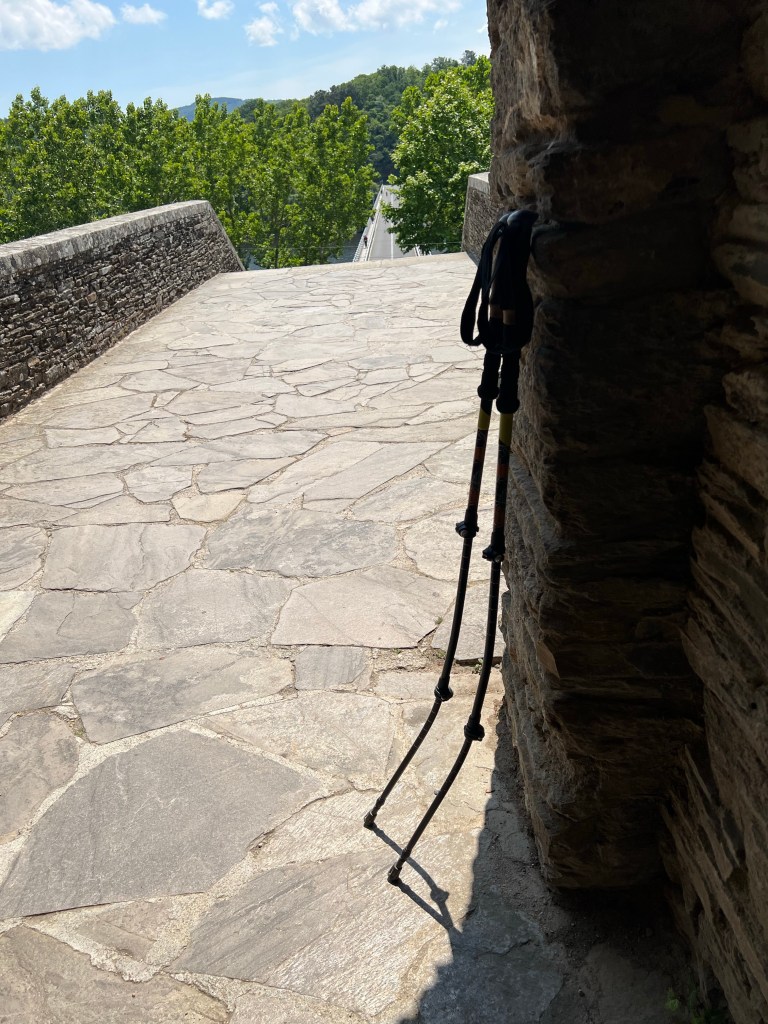
At the top of the bridge, my hiking poles broke the fall of a fellow peregrino who had turned to take in the view. He was not hurt, but my poles were bent into two perfect crescent moon shapes.
He was very apologetic, but I told him as best I could that it was not a serious problem, and that the important thing was that he was not hurt. Falling down even part of those stairs could be serious.
I learned later that the arched bridge could be avoided on surface streets. This would be advisable, since it is a long climb with a heavy pack and no handrails.
I walked a few more blocks to my albergue and checked in.
I showed the hospitalera my bent poles and asked if there were a peregrino shop in town. She said there wasn’t. After a moment, she excused herself and came back with a set of poles that someone had left behind in previous years. As they say, “the Camino provides!”
(I will re-donate the poles to the next needy pilgrim at the end of my journey).
The albergue was huge, with 120 bunk beds in a single large room, separated into groups of 40 with hanging sheets.
There was a strong smell of insecticide, which I took as a hopeful omen for the lack of bedbugs.
I managed to get a lower bunk and started setting up my sleep space.
There is a method for dealing with sleeping albergues, and it is more work than staying in hotels. First, you need to store your dusty shoes and poles in the designated place, generally near the entrance. Then, you make up the bed if sheets are provided. Most people travel with a sleeping bag liner in case they are not.
Then, you organize whatever you might need in the night before stowing your pack. I used my lightweight day pack to collect toiletries, bath towel, electrical charges, ear plugs, water, etc.
On a lower bunk, you can use an S hook to hang your day pack out of the way (if you remembered to pack one).
Then shower, laundry, and finding an AC outlet (if you’re lucky). I was happy for the extra weight of my portable charger on these nights.
This particular process was was complicated by the arrival of the group of 100 or so eighth-graders. They were hiking with day packs, but a bus soon arrived with their suitcases, making the narrow aisles very tight.
There are always a few hours to kill between your arrival at, say, 3 and your dinner at 8 or 9. This is a perfect time to rest after your long hike, and maybe take a nap.
But not with 100 eighth-graders. It’s not that they were poorly behaved, but they were loud, playing games and jumping from bunk to bunk like spider monkeys.
Earplugs afforded me a little rest before going out to inspect the 100 meters or so of downtown in this small city. The cathedral was locked, as most things are between 3 and 6.
If you can push your dinner as late as possible when staying in an albergue, you’ll come back at around 9:30 before the doors lock at 10.
There were no blankets on the beds at this albergue. Some people travel with a light blanket in their pack. It was cold, so I asked if I could rent a blanket, as I had done at another place. The hospitalera said to check again at 9:00.
The young people were fairly quiet after lights-out. I realized that one advantage of having them there in such a huge room was that there were relatively few snorers—the bane of albergue sleeping.
Someone wished me “Ultreia” on the Camino today. It’s a special greeting among pilgrims, in Latin, with a historic meaning along the lines of, “go beyond.”
The much more common day-to-day greeting for pilgrims on the Camino is “Buen Camino.” Google Translate insipidly renders this as, “Good Way,” but what it really means is, “Happy Camino.”
Peregrinos hear this from other pilgrims, often as a polite way of saying, “let me get past you,” but also from non-pilgrims, who seem genuinely supportive. In traffic, cars will sometimes honk in support.
In my 40+ years of world travel, Americans are rarely regarded in such high esteem.
The hike into Sarria was a long, steady climb through forests and rolling hills. It was cold most of the day—in the 50s F.
The city is known as a convergence point for peregrinos from all over the world. Many start their Camino here to complete the final 111 km over 6 days.
Unlike many cities on the Camino, Sarria is actually growing. There is no amazing architecture here—just a ruined castle from the Middle Ages, but the city itself has pre-Roman Celtic roots.
The Galician language is said to have some elements of Gaelic, and the landscape in places is similar to Ireland and Scotland.
I haven’t heard them yet, but there are bagpipes here.
Tomorrow is a 23 km hike to Portomarin. Saving my last dose of cold medicine for the albergue, so I don’t keep everyone awake.
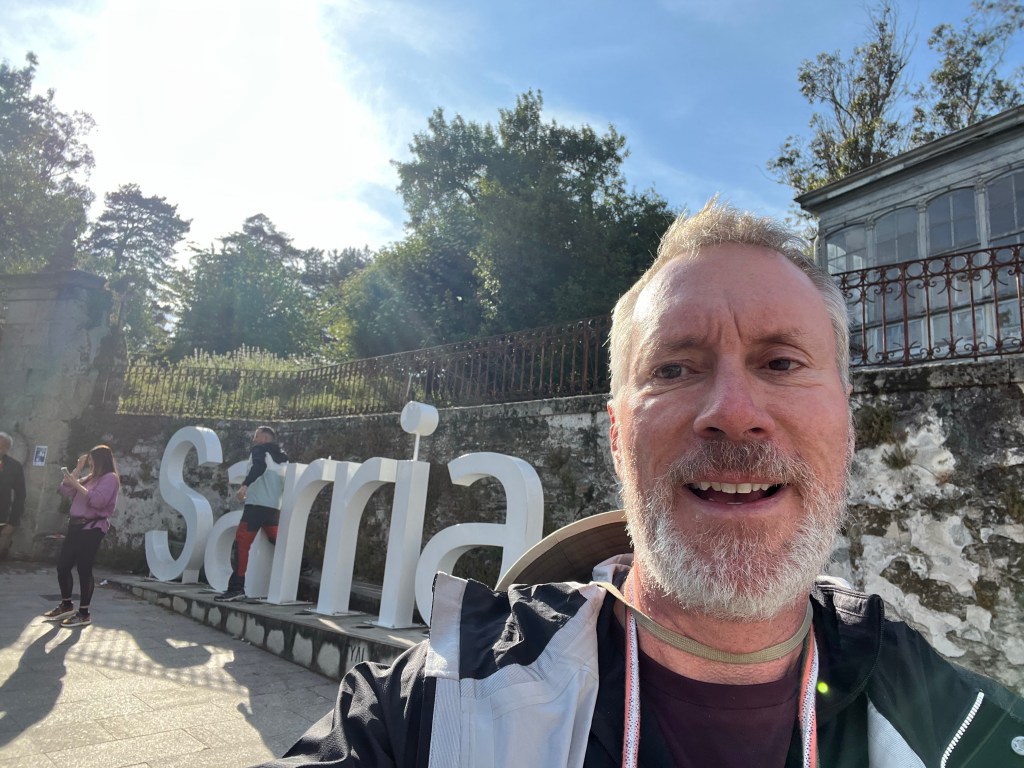
Arriving in Sarria, the traditional start of the Camino de Santiago
Outside the church in O Cebreiro there is an unassuming bust of a priest named Don Elias Valiña Sampedro, who served as the parish priest until his death in 1989.
A scholar and writer on the Camino de Santiago, he is responsible for reviving the popularity of the Camino Francés in the 1980s.
Beginning in Roncesvalles in 1984, Don Elias started a process of clearing the trail, restoring the markers, and painting the ubiquitous yellow arrows that show peregrinos “the way.”
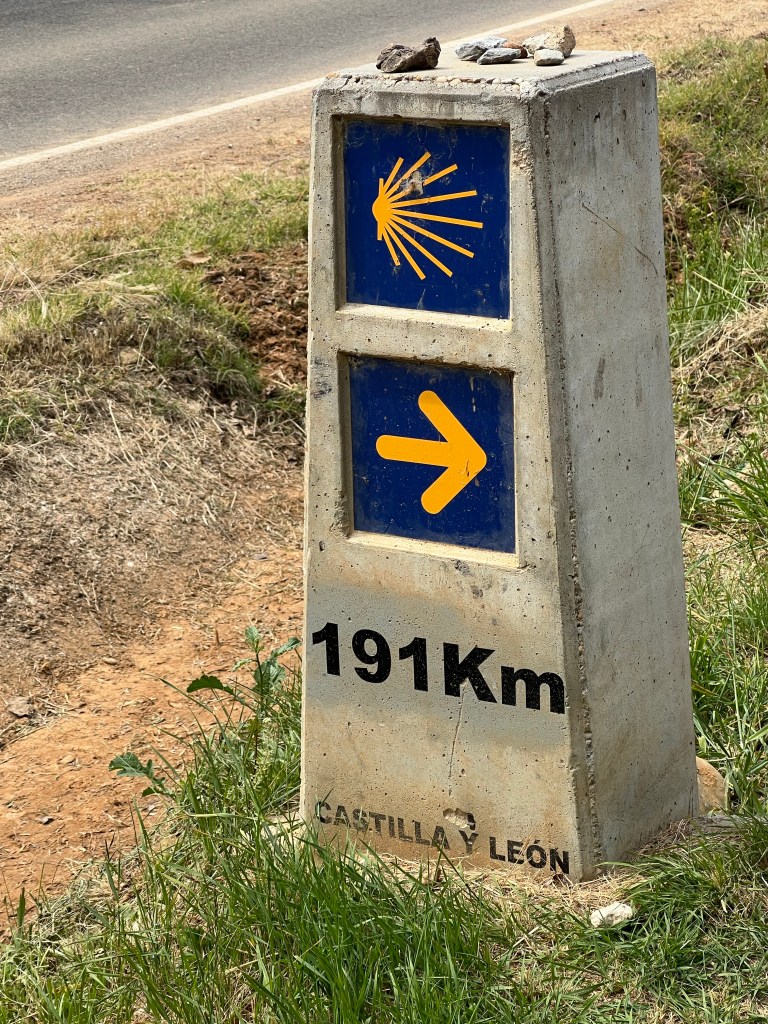
The concrete pylons are sometimes far apart, but you can always find a yellow arrow on a wall, a tree, or the street if you’re not sure.
Don Elias said he was once pulled over by police, who were alarmed by the gallons of yellow paint in the back of his Citroën GS. It is a very specific yellow, and one learns quickly to spot the arrows here.
What Don Elias did may or may not have been legal, but today’s peregrinos owe the existence of the ancient route to him.
Triacastella is a small city named after 3 castles, none of which still exist. It lies beyond the Alto de Poio at 1,335 meters. A pretty good slog, it it felt fine to be carrying my pack again today.
I’ll be sleeping in pensiones (simple, one-star hotels) and albergues for the next week. Tonight’s bed is in a comfortable hostal called Casa Simon, run by a hospitalero named Johann.
Tomorrow I will hike to Sarria, the traditional start of the last 100 km to Santiago. I will need to get two sellos a day in my pilgrim’s passport to qualify for my compostela certificate in Santiago.
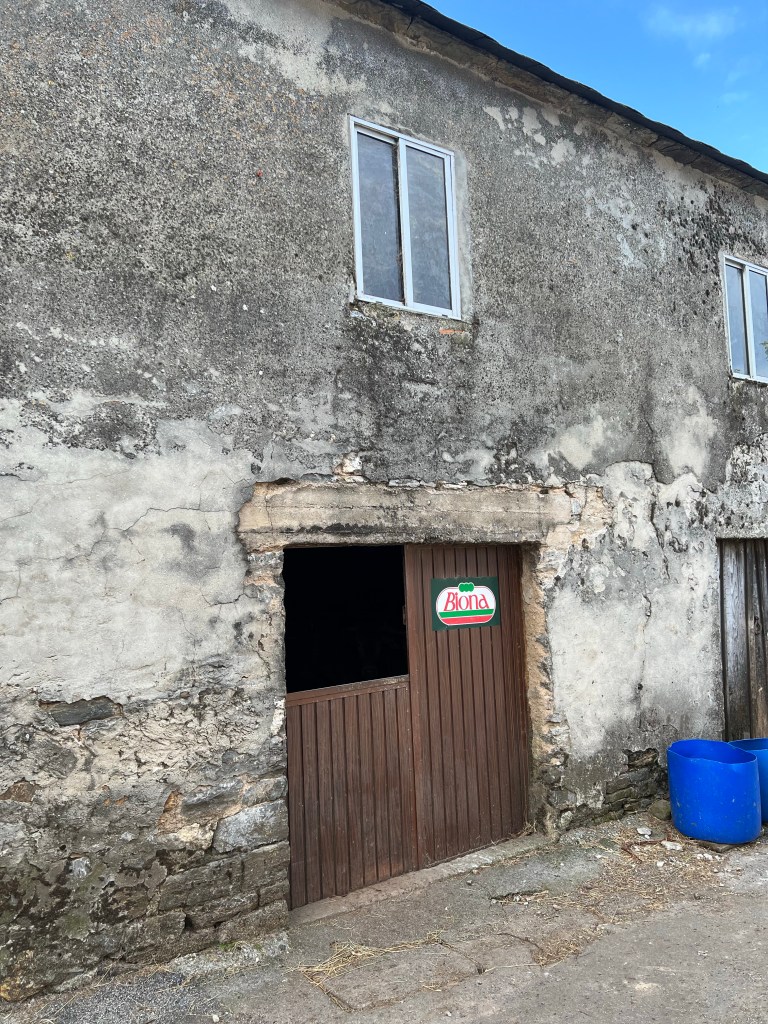
Cows on the bottom, people on top. Very common in rural Spain.
The climb to O Cebreiro is considered the second most challenging on the Camino Francés.
The first 20 km from Villafranca are mostly flat, with a few rolling hills. It the last 10 km is a step ascent into Galicia along a rocky path.
Makes for a long day.
The terrain has changed considerably over the past two days. Rather than large, flat fields, this region has an increasingly diverse topology and is very green, with numerous villages dotting the valleys and ridges.
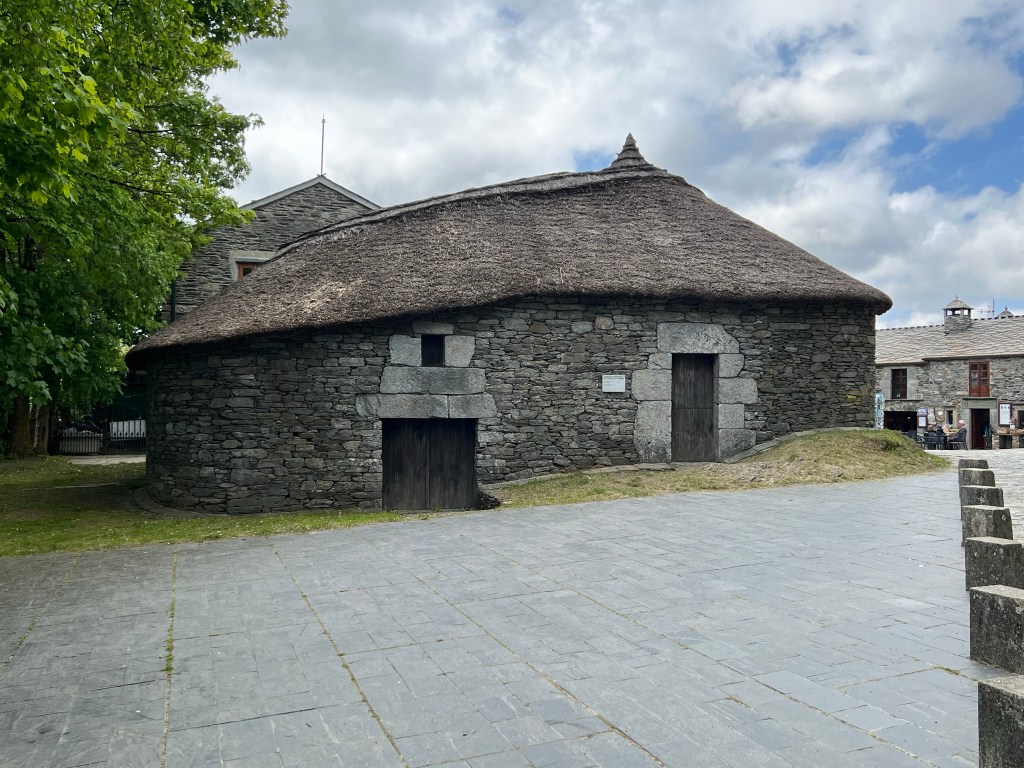
One of the guidebooks calls O Cebreiro a “hobbit town,” and the description is pretty apt. The few buildings here have a charming, improvised feel. Many have been converted to souvenir shops to accommodate the peregrino trade.
Who buys souvenirs with one, two, or three more weeks of hiking ahead of them? Someone who sends their luggage ahead every day, that’s who.
There are virtually no beds here, so everyone books in a nearby village. My hostal was supposed to be 2 km away, bit it turned out to be 5. A bit too much after a 30 km day, so I shared a cab to the place where I’d made my booking.
The woman who checked me in arranged for a taxi to pick me up in the morning. There is a wonderful efficiency in how the environment has adapted to the needs of peregrinos. I remember thinking the same thing about Peru when Victoria and I visited Machu Picchu a few years ago.
To make sure I have time for a bite to eat before my taxi arrives, I’ll set my alarm for the morning, although the church bells generally start ringing at 6. I’m going to miss the church bells when I get home.
It is a rule in the albergues, and common practice among pilgrims, to respect a 10 PM lights out. Peregrinos get up early. But, again thanks to Franco, it doesn’t get dark here until around 10:30. I can’t say with any confidence that I’ve seen “night” in all this time in Spain.
Once a home, now a curio shop. Bagpipes welcome you to Galicia.
Felt quite a bit better today and completed the 24 km to Villafranca del Bierzo (guidebook said 21, but I’ve learned to take these estimates with a grain of salt).
It’s a charming little place with several medieval buildings and a huge church, the Iglesia Colegiata.
A curiosity on the way into town is the Romanesque Iglesia de Santiago. A posting says that its doors open only in holy years to pilgrims who are too sick or to weak to complete the journey to Santiago de Compostela.
By special dispensation, a pilgrim can receive his Compostela certificate without completing the final 191 km to Santiago.
I somehow beat the luggage delivery service to my hotel, but only by about an hour. I’ll forward once more tomorrow and hopefully be back to 100% the following day and carrying my pack.
The hospitalero marked several dinner spots on the map and circled the huge Colegiata, saying that a pilgrim’s meal would be served there at 19:30.
That sounded great to me, so I walked to the building at the appointed time and found…a beautiful, empty church. No pilgrims, no meal.
I had a nice dinner anyway at another place of local food, including a piece of spicy sausage and some part of a pig that has many, tiny bones. It was a bit of work, but worth it.
Tomorrow begins the long, steep climb into Galicia.

 Don's Camino